
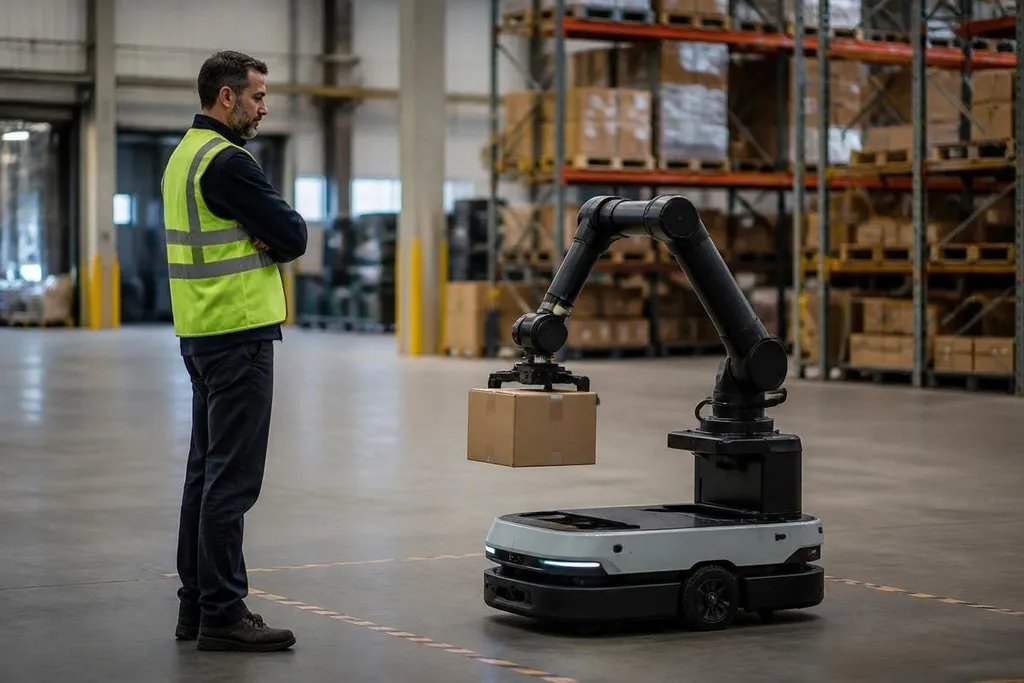
A robot can lift a box, drive through a warehouse, or sort medical samples. The harder question is whether people can rely on it when the task changes, a sensor fails, or the system makes a wrong choice.
- Trust needs records, limits, and a clear person in charge.
- A smooth demo says little about long-term reliability.
- Buyers should ask what happens after failure, not only what happens during normal work.
Trust starts with visible limits
People trust a robot more easily when its limits are clear. A mobile robot should state where it can drive, what floor surfaces it supports, how close it may pass to people, and when it must stop.
That detail gives an operator something useful to check. A claim such as “works in busy sites” leaves too many gaps. A useful description might state a speed of 1.5 m/s, a maximum slope of 10 degrees, and the lighting range needed by its cameras.
Those figures still need proof. The maker should show test conditions, failure rates, and the point at which the robot handed control back to a person.
Without that record, a specification is a starting point rather than a reason to trust the system.
Reliability is more than a successful demo
A demonstration usually shows a planned task in a known setting. Daily work adds blocked paths, damaged packages, changing light, weak wireless signals, and people who do things the test team did not expect.
Trust grows when a robot records those events and makes the records available. A buyer should be able to see how often the robot stopped, how long recovery took, and whether a person had to intervene.
The same rule applies to software updates. Each update should have a date, a list of changes, and a way to return to the previous version. That process gives the site team a clear answer when a new fault appears after an update.
For a robotics company, that record matters as much as the machine. Dated robotics reporting from Robot24.com can connect a product claim to its test site, software version, and deployment record, giving buyers something they can check when the next fault appears.
Safety needs a named owner
Even when a robot stops after seeing a person, someone still has to decide where it may operate and how it should be checked. Trust breaks down when responsibility sits between the maker, the integrator, and the site owner.
A deployment plan should name the person who can stop the system, approve a restart, and review an incident. It should also state the inspection schedule and the time allowed for a repair.
That owner needs more than a dashboard. They need access to the robot’s event log, fault codes, camera settings, and remote-control records. These details help separate a sensor fault from a map error or a human setup mistake.
I’d trust a slower robot with clear failure records before a faster one that hides them.
Data changes the trust question
Robots that use cameras, microphones, maps, or location data raise a second concern. People need to know what the robot collects, where the data goes, and how long it stays there.
A plain data policy should name each sensor, the purpose of its data, and the people who can view it. It should also explain what happens when a customer asks for deletion or when the contract ends.
This matters in a warehouse, hospital, office, or public space. A robot may record people who never agreed to take part in a test, so the site needs rules before the machine starts work.
A practical trust check
Before buying or approving a robot, ask for these items in writing:
- Task limits: speed, payload, floor conditions, lighting range, and stop distance.
- Failure records: stopped tasks, human interventions, recovery time, and fault codes.
- Update control: release dates, change notes, rollback steps, and support contacts.
- Safety ownership: the person who can stop the system and approve a restart.
- Data handling: sensors, storage location, access rights, retention period, and deletion steps.
- Incident process: who gets the report, how fast the maker responds, and what happens after a repeat fault.
Evidence earns trust when people can inspect it before and after deployment. The next useful question for any robotics buyer is simple: when the machine fails on a normal Tuesday, who knows why, who can stop it, and how fast can the work resume?